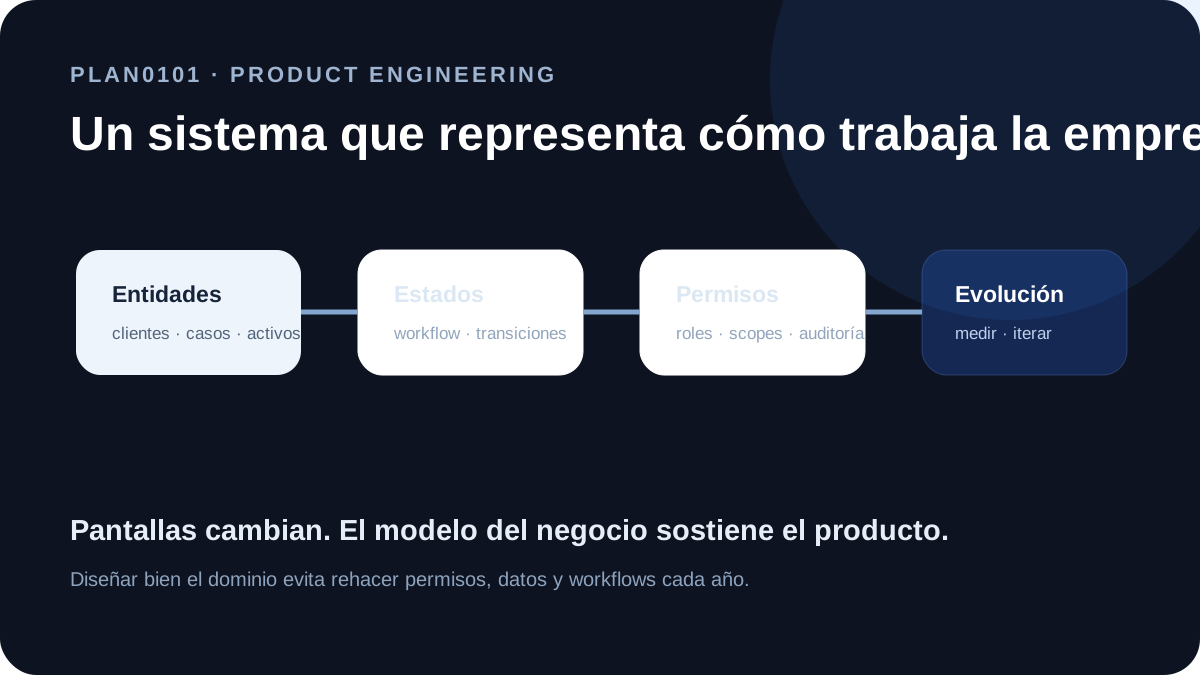
Model the business before the interface
Scalable internal software is built around entities, states, rules and responsibilities. If a project starts by copying a spreadsheet or drawing screens without understanding those relationships, the interface can look polished while the underlying model fails as soon as new roles or exceptions appear.
Describe the workflow as events before implementation: what starts a case, who can move it, which information is required and which external systems must be notified. That model becomes the foundation for data and authorization.
- Business entities.
- Valid states and transitions.
- Roles and permissions.
- Events and notifications.
- Integrations and sources of truth.
Establish sources of truth and integration contracts
When an entity exists in several systems, define which system is authoritative for each field. The CRM may own contact data, finance software may own invoices and the internal system may own operational workflow. Ambiguity is what creates reconciliation work.
Integrations also need explicit contracts: stable identifiers, versioned payloads, idempotency, retry behavior and failure recovery. A webhook is not reliable integration architecture if failed events disappear without a recovery path.
- Stable cross-system identifiers.
- Idempotent handlers.
- Bounded retries and dead-letter handling where appropriate.
- Correlatable logs.
- Versioned APIs or events.
Make observability a product capability
As more operations depend on internal software, answering what happened and why becomes a product requirement. Technical logs serve engineering; business history serves operations and support.
Track meaningful state changes, actor, timestamp and context without retaining unnecessary secrets. For automation and AI, distinguish the recommendation, decision and action that was actually executed.
- Business change history.
- Structured technical logs.
- Error and latency metrics.
- Alerts around critical workflows.
- Automation traceability.
Scaling also means changing safely
Most internal systems do not fail because they cannot handle massive traffic. They become expensive because every change touches too many areas. Clear domain modules, stable internal interfaces and centralized business rules reduce that coupling.
You do not need a distributed architecture on day one. You do need a structure where adding a new state, integration or role does not require rewriting the whole product.
- Domain-oriented modularity.
- Business rules outside UI components.
- Reproducible database migrations.
- Tests for critical workflows.
- Gradual rollout for risky changes.
Frequently asked questions
Should internal software start with microservices?
Usually not. A modular monolith is often simpler and scales well for many companies. Separate services when operational or domain boundaries justify the added complexity.
What matters more, UI or data model?
Both matter, but incorrect data and authorization models constrain the entire product. UI can iterate quickly when the underlying domain is represented correctly.
How do we prevent internal software from becoming obsolete?
Keep integrations decoupled, document decisions, measure usage and maintain an evolution cycle. Scalability includes the ability to change without disrupting the operation.
Design the operating system before technical debt becomes the process
PLAN0101 combines workflow discovery, architecture and product engineering to build software that can grow with the business.
Explore product engineering