Start with the operation, not the technology
Custom software is not automatically better than SaaS. Standard software is usually the right choice for standardized, non-differentiating work. Building becomes more compelling when the company is changing its workflow to fit tools that no longer represent how the business actually operates.
License price alone is a weak comparison. Total cost includes manual reconciliation, duplicate entry, broken integrations, add-ons, reporting work, permission limitations and opportunities lost because information arrives too late.
- Buy for mature, common processes.
- Build around workflows that are strategic and genuinely specific.
- Use a hybrid architecture when mature services can handle commodity capabilities.
Signals your SaaS stack is becoming the problem
The first signal is often a spreadsheet beside the official system. Teams export, clean and re-enter data because the application cannot express an exception or cross-functional workflow. Another signal is knowledge concentration: one person becomes the integration layer between several tools.
Fragmented data matters even more. When sales, operations and finance each have a different version of the same customer or deal, another application can create one more source of truth instead of fixing the architecture.
- Critical spreadsheets outside the system.
- Repeated copy-and-paste between applications.
- Business rules that cannot be represented cleanly.
- Weekly exports required to produce basic reporting.
- Manual recovery when integrations fail.
When custom software creates leverage
Building is easier to justify when a system removes a repeated bottleneck, consolidates essential operational data or enables a workflow competitors cannot obtain by buying the exact same product. Volume amplifies the effect: a small inefficiency repeated thousands of times becomes a material cost.
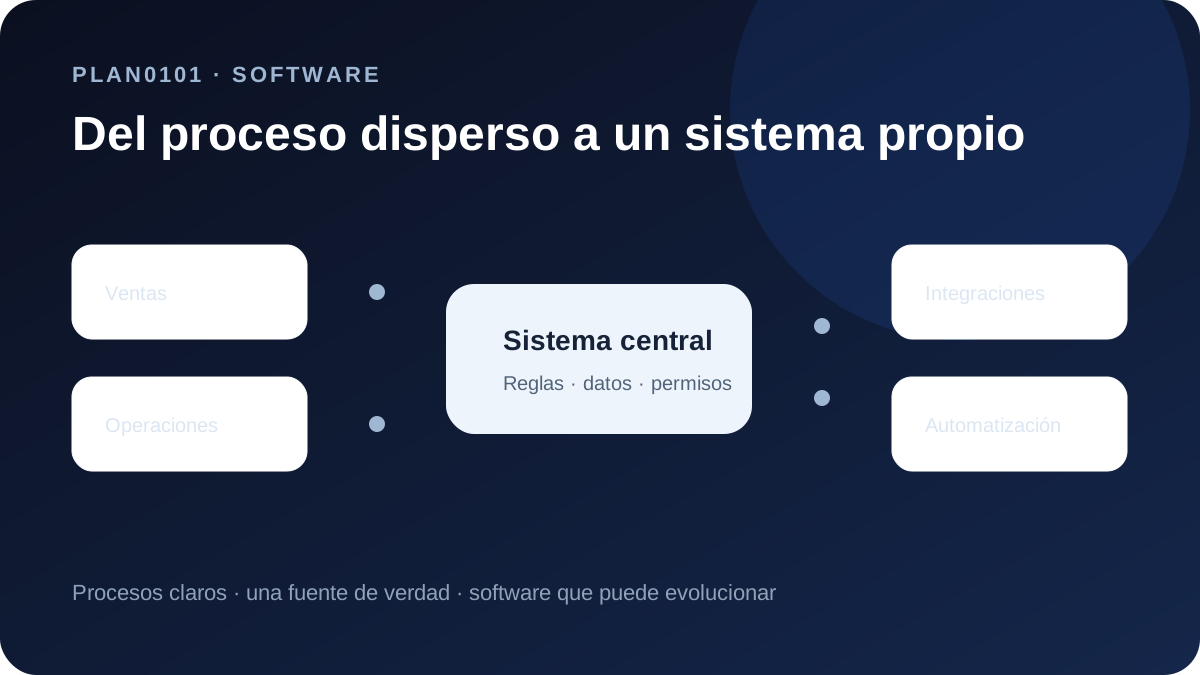
The best initial scope is rarely a replacement for everything. It can be a command center, workflow engine, integration layer, sales operations system or automation core that connects the tools worth keeping.
- The workflow is central to how the company creates value.
- Manual work is high-volume and recurring.
- Specific permissions, states or approvals are required.
- Several tools need synchronized data.
- Traceability and audit history matter.
Compare total cost and strategic risk
For SaaS, include subscriptions, seats, modules, consultants, integrations and internal labor. For custom software, include discovery, development, infrastructure, maintenance and product evolution. Then add the most frequently ignored line: the cost of leaving the operational problem unresolved.
Risk also changes form. Buying reduces delivery risk but creates dependence on a vendor's roadmap and pricing. Building provides control but requires product discipline, security and maintenance. A good decision makes both tradeoffs explicit.
- Annual direct cost.
- Internal labor consumed by workarounds.
- Error and rework cost.
- Vendor or key-person dependency.
- Time to value.
- Ability to evolve the workflow.
A practical decision process
Map the current process before selecting technology. Identify inputs, decisions, roles, systems and outputs. Mark where data is rewritten, where work waits and where decisions rely on incomplete context. Only then compare available products against a tailored system.
If a standard tool covers the operation without forcing major workarounds, buying usually wins. If the missing portion is exactly where the business differentiates, build that portion and integrate it with the rest of the stack.
- Define the problem in operational terms, not feature lists.
- Start with the highest-impact workflow.
- Preserve data portability and integration options.
- Measure adoption, cycle time and data quality after launch.
Frequently asked questions
Is custom software always more expensive than SaaS?
No. It usually requires a larger initial investment, but it can be more economical when it replaces several licenses, removes significant recurring labor or reduces operational errors.
Should a company replace its whole software stack?
Usually not. Hybrid architecture is often stronger: keep mature commodity services and build the operational layer that creates unique value.
How can we start without a huge project?
Choose one high-impact workflow, a small set of essential integrations and measurable outcomes. Expand only after the first release produces evidence.
Not sure whether to buy, integrate or build?
PLAN0101 maps the operation and turns constraints into a concrete software recommendation before development starts.
Evaluate the project with AI