The signal is usually operational fragmentation
Companies rarely run out of software. More often, the real process lives between spreadsheets, messages, documents and individual knowledge while each SaaS product owns only one fragment. Teams become the integration layer.
A custom internal system can provide the operating core: customers, orders, work items, states, owners and business events. It can then connect to external products that still solve specialized problems well.
- Critical data duplicated across spreadsheets.
- Status updates communicated manually.
- Approvals with weak auditability.
- Reports built through recurring exports.
- Processes that depend on one key person.
Start with entities and workflow, not a module list
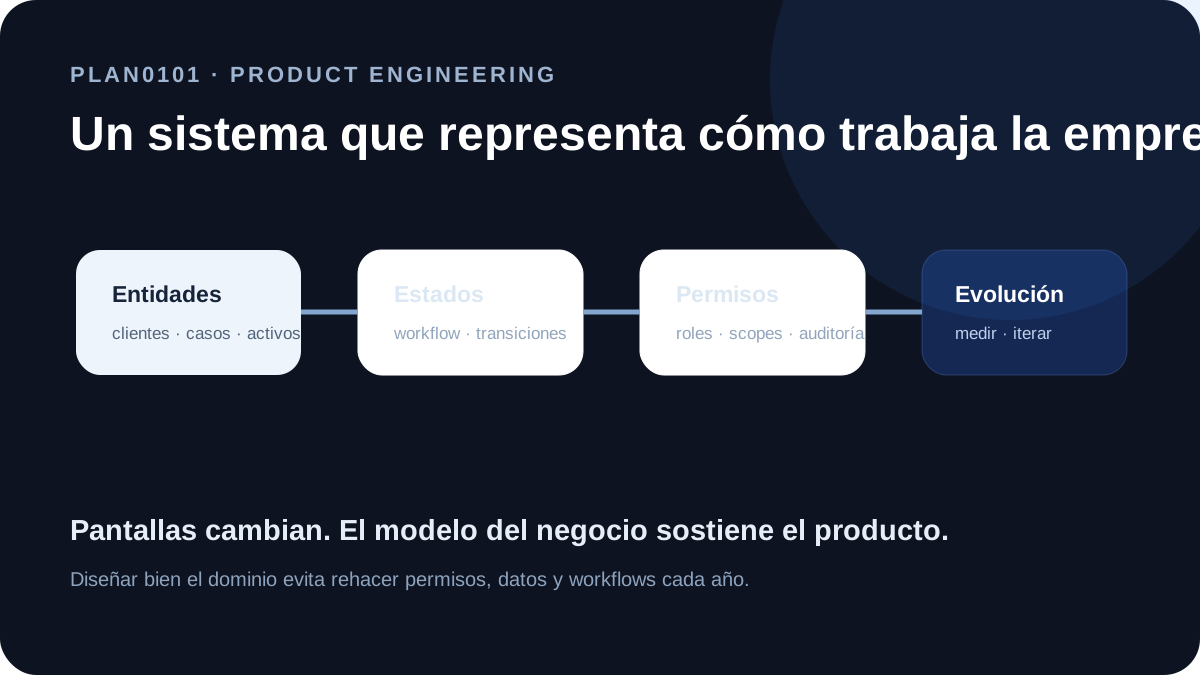
The first release normally needs identity, roles, core entities, workflow, activity and an operational view. The exact modules should emerge from those pieces rather than from copying the navigation of an existing tool.
A logistics operation may begin with orders, routes, incidents and delivery states. A services company may need customers, engagements, tasks and approvals. The domain model is what keeps the product coherent as new features are added.
- Users, teams and roles.
- Core business entities.
- States and allowed transitions.
- Activity, files and comments.
- Work queues and exception views.
Prevent the new system from becoming another silo
A new interface does not solve fragmentation if people still copy data between tools. Integrations and source-of-truth decisions therefore belong in the initial architecture, not in a later cleanup phase.
Adoption also improves when the product reduces navigation. Each role should be able to see what needs action instead of searching across modules. A useful work queue often creates more operational value than a large executive dashboard.
- Define ownership for each important data field.
- Automate recurring synchronization.
- Design views around role-specific work.
- Remove fields that do not support decisions.
- Measure adoption by completed workflow.
Design for change from the beginning
Internal software evolves as the business changes. New teams, rules, customers and integrations appear after launch. Separating the domain model, permissions, business logic and interfaces makes those changes less expensive.
Documentation and integration contracts matter too. A product that only the original developers understand can become operational debt even if its codebase is technically sound.
- Explicit domain model.
- Backend-enforced authorization.
- Documented APIs and integration contracts.
- Audit logs for sensitive actions.
- Deployment and operational documentation.
Frequently asked questions
Does custom internal software replace the ERP?
Not necessarily. It can sit alongside ERP, CRM and other systems and own the workflows that are specific to the company's operation.
When are spreadsheets no longer enough?
When they contain critical state, require recurring reconciliation, depend on a key individual or make it difficult to know the real operational status.
Can we start with one workflow?
Yes. A focused workflow with measurable impact is usually the safest first release and can become the foundation for adjacent processes later.
Map the internal system your operation actually needs
PLAN0101 builds software around real workflows, permissions, integrations and operational data.
Explore custom software