Company size is not the reason to build
An SMB does not need custom software simply because it is growing. The decision depends on process friction, frequency and the cost of forcing a distinctive workflow into generic tools. Standard processes are usually better served by mature SaaS.
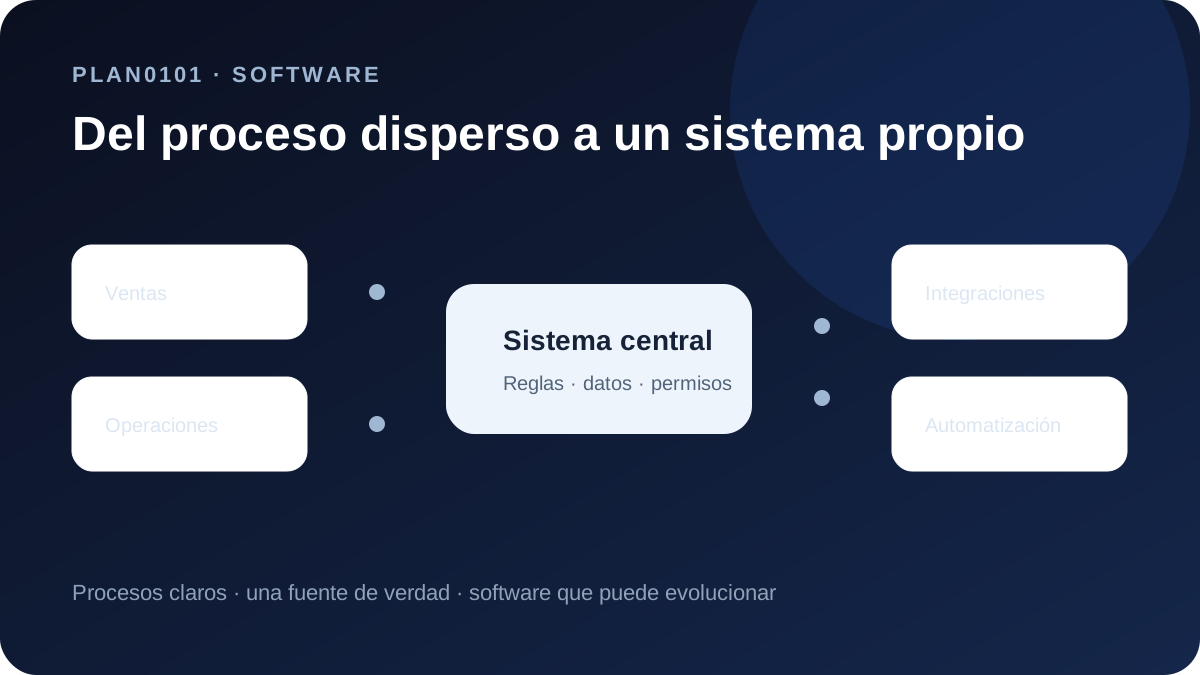
Building becomes more reasonable when the operating model has grown around spreadsheets, messaging, CRM, documents and internal knowledge and that combination now creates recurring manual coordination.
- High-frequency operational process.
- Business-specific rules generic tools cannot model well.
- Data spread across multiple systems.
- Manual work that scales with every new customer.
- More specific permissions or traceability needs.
Test three alternatives before building
First check whether an existing SaaS product can cover the workflow without distorting it. Then test whether integration removes duplicate entry. Finally consider a focused automation. If a strategic core still remains manual, custom software becomes a stronger option.
This sequence avoids turning development into the default answer. A small integration layer can sometimes solve most of the problem with lower cost and risk.
- Buy when the process is standard.
- Integrate when systems already have the required functions but do not share data.
- Automate when rules are stable and repetitive.
- Build when the operating core is genuinely specific.
Start with one complete high-impact workflow
The first release might cover sales follow-up, order management, approvals, a customer portal or operational data consolidation. It should be complete enough to use, not a disconnected set of mock screens.
Reducing scope does not require disposable architecture. It means fewer modules, fewer secondary integrations and less configurability until usage proves what should come next.
- One primary user type.
- One complete workflow.
- Only essential integrations.
- One measurable improvement target.
- Explicit next-stage plan.
Measure return in time, errors and operating capacity
For an SMB, value often shows up as fewer administrative hours, lower rework, less dependence on key people and the ability to handle more volume without adding manual coordination at the same rate.
You do not need to assume a universal ROI. Establish the baseline first: time per case, manual steps, frequency and common errors. Then judge the first release against that operating reality.
- Time per case before and after.
- Repeated data entry.
- Errors and rework.
- Customer response time.
- Volume the same team can support.
Frequently asked questions
Is custom software only for large companies?
No. It can make sense for an SMB when it solves a recurring strategic friction and the first release is deliberately scoped.
How do I know whether integration is enough?
If your existing tools already perform the required functions but people copy data between them, the first problem is probably integration rather than a new product.
What should the first version include?
One complete high-impact workflow with the minimum data, permissions and integrations required for real use.
Decide whether to buy, integrate, automate or build
PLAN0101 starts with the workflow and chooses the smallest intervention that meaningfully solves the problem.
Evaluate my case